In pharmaceutical marketing, healthcare providers and patients require different language and separate regulatory review tracks. The marketing collateral program supporting a single drug can span a dozen materials, produced on overlapping timelines, subject to approval processes that don’t always cooperate with launch dates.
Most industries treat print collateral as a supporting piece. But in pharma, it’s highly contextual. A field rep walking into a physician’s office needs materials that are accurate and clinically credible for a conversation that might last ten minutes. A patient starting a new therapy needs information that’s clear and reassuring at what is often an anxious moment. Getting both of those things right, consistently, across a full program, is harder than it looks from the outside.
Why Pharma Collateral Is a Category of Its Own
Few industries carry the production and compliance weight that pharmaceutical marketing does. Every piece of collateral operates within a regulatory framework and must have the most current approved language before it ships. For many materials, that means clearing internal and external review cycles that run right up against production deadlines.
A brochure that goes out of date the week after a label update is both wasted budget and a compliance liability. A patient kit assembled with the wrong co-pay card insert erodes the brand experience at the exact moment a patient is deciding whether to begin treatment. The stakes attached to accuracy and version control are concrete operational realities in this industry, not abstract concerns. Knowing which materials serve which purpose and what each one demands in production is where a well-run brand program starts.
Materials That Support the HCP Conversation
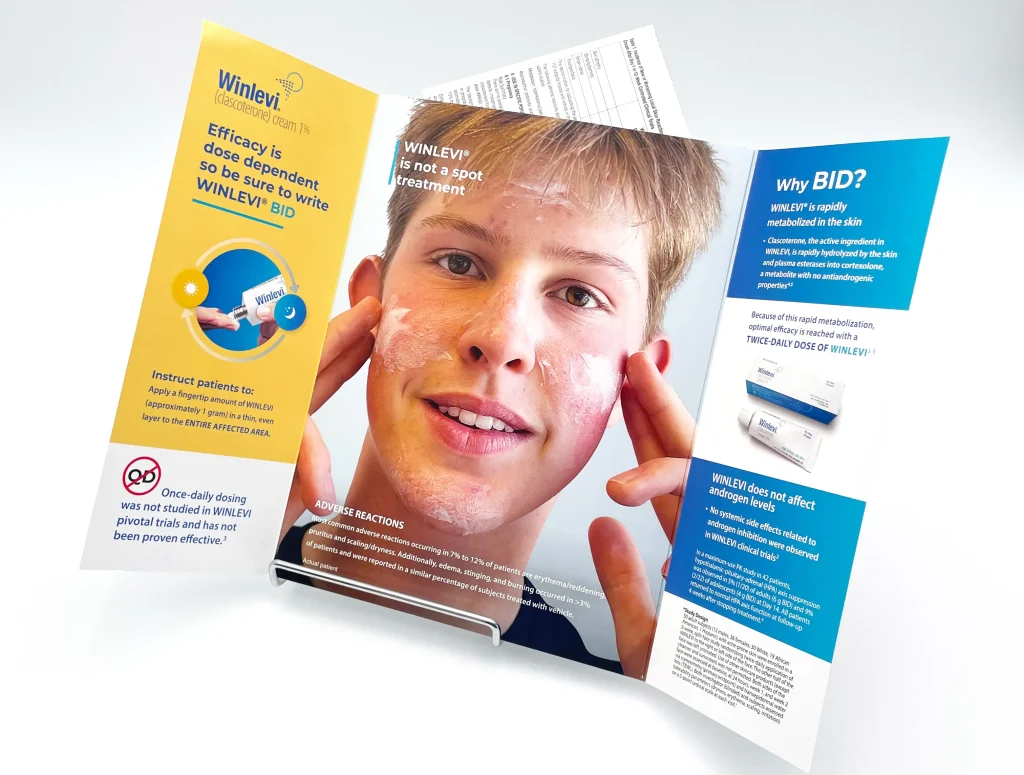
A sales representative typically has a limited window with a physician or specialist. The materials supporting that conversation have to hold up to clinical scrutiny and move things forward, all without overstating what the data supports. HCP-facing collateral is precision work.

Sales Aids and Detail Aids
Detail aids are the primary tool a field rep uses during a physician visit. A well-constructed detail aid carries the conversation in a logical sequence: the disease state, the unmet need, the mechanism of action, clinical data, and the call to action. Visual hierarchy and chart quality influence how effectively the rep can guide that conversation, as does the physical format of the piece itself.
Digital formats and modular leave-behind components have expanded what detail aids can do, but the underlying requirement is still clinical accuracy, paired with a structure that doesn’t waste the limited time a rep has in the room.
Dosing Guides and Dosage Aids
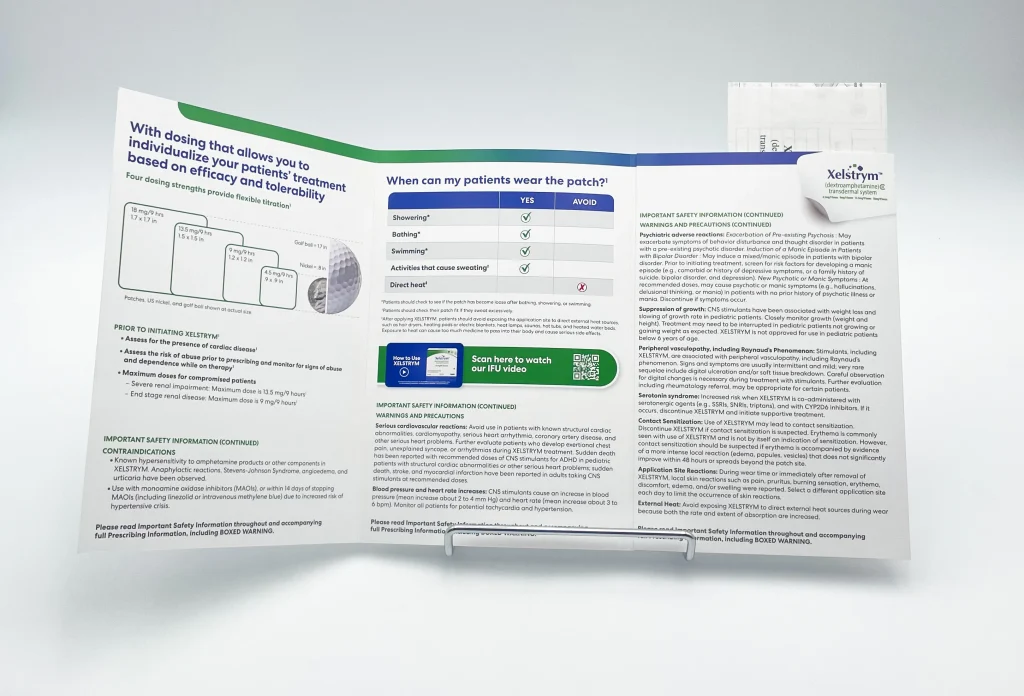
For complex therapies with titration schedules or weight-based dosing, a dosing guide is an important resource that lives in the exam room long after the sales visit ends. The job of a dosing guide is quick reference. When a physician is about to write a prescription, the piece has to answer the relevant question immediately, in a format that doesn’t require hunting for information.
Medical and Educational Brochures
Educational brochures give HCPs a deeper resource for understanding a therapy’s mechanism of action and its place in the clinical evidence base. Unlike a detail aid, a medical brochure doesn’t have to move at the pace of a sales conversation. It can carry more information and support clinical decision-making over time, functioning as a reference that gets consulted between visits. The challenge is balancing depth with readability. A document that reads like a journal abstract rarely gets picked up a second time.
Prescribing Information
Prescribing information (PI) is the official FDA-approved documentation accompanying a drug, and it carries the full weight of regulatory authority. PIs document everything from approved indications and dosage guidance to contraindications and adverse events. They are not marketing materials in the traditional sense, but production and distribution are still part of every brand program. Their production requirements are governed by labeling regulations and leave no room for variation in folding specs or print density.
What makes HCP-facing materials effective as a set tends to come down to a few consistent factors:
- Clinical accuracy that can withstand scrutiny from a skeptical prescriber
- Language that respects the physician’s intelligence without burying the key message
- Formats sized and structured for how HCPs actually interact with them, in brief moments and often on the go
- A version control process that keeps all materials current across label updates and indication changes
Materials That Support the Patient Journey
Patients encounter branded pharmaceutical materials at nearly every stage of treatment, from starting a new therapy to navigating cost barriers at the pharmacy counter. Each touchpoint calls for a different kind of communication, and the materials produced for those moments have to earn attention through clarity.
Patient Starter Kits and Welcome Kits
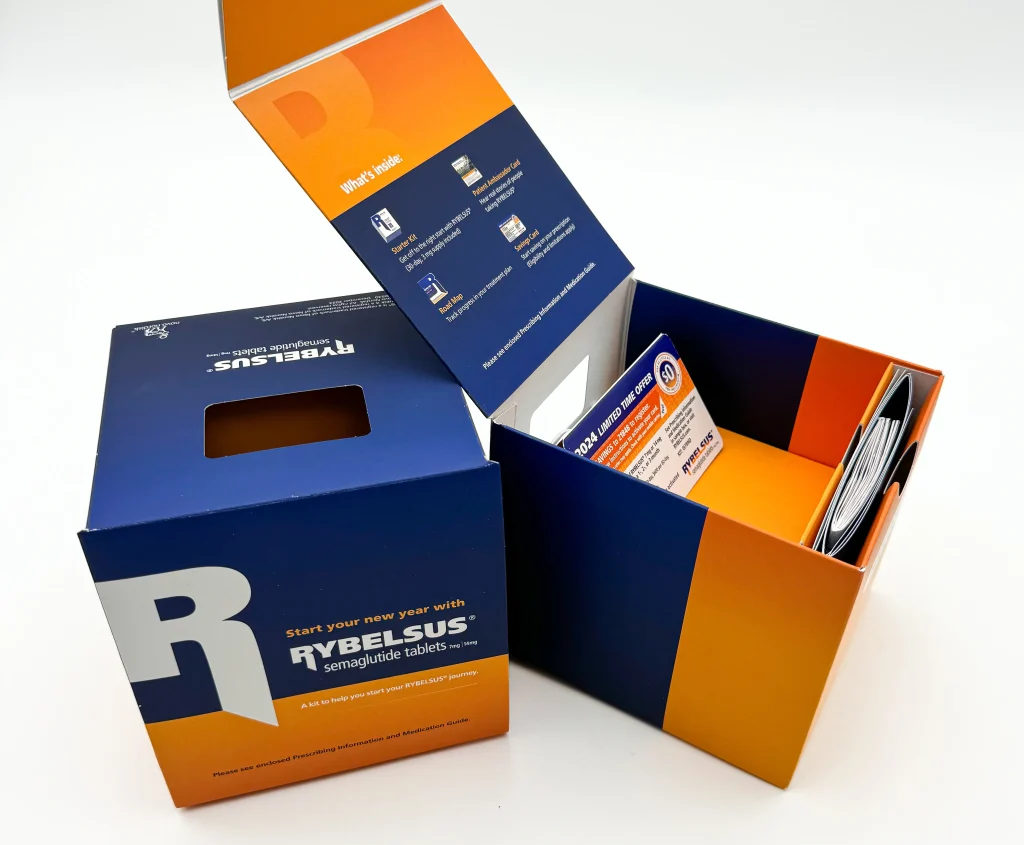
A patient starter kit is typically provided through a physician at the point of prescribing, often including a starter supply of the medication along with educational materials and the supporting tools designed to help a patient begin treatment with confidence. A well-constructed starter kit signals that the brand has invested in the patient’s experience beyond the transaction itself.
Some starter kits involve a small number of components. Others include a medication supply, an educational booklet, a co-pay card, a symptom tracker, and specialty items like an applicator or storage case. Each configuration requires precise kitting to ensure every patient receives the correct version.
Tearpads
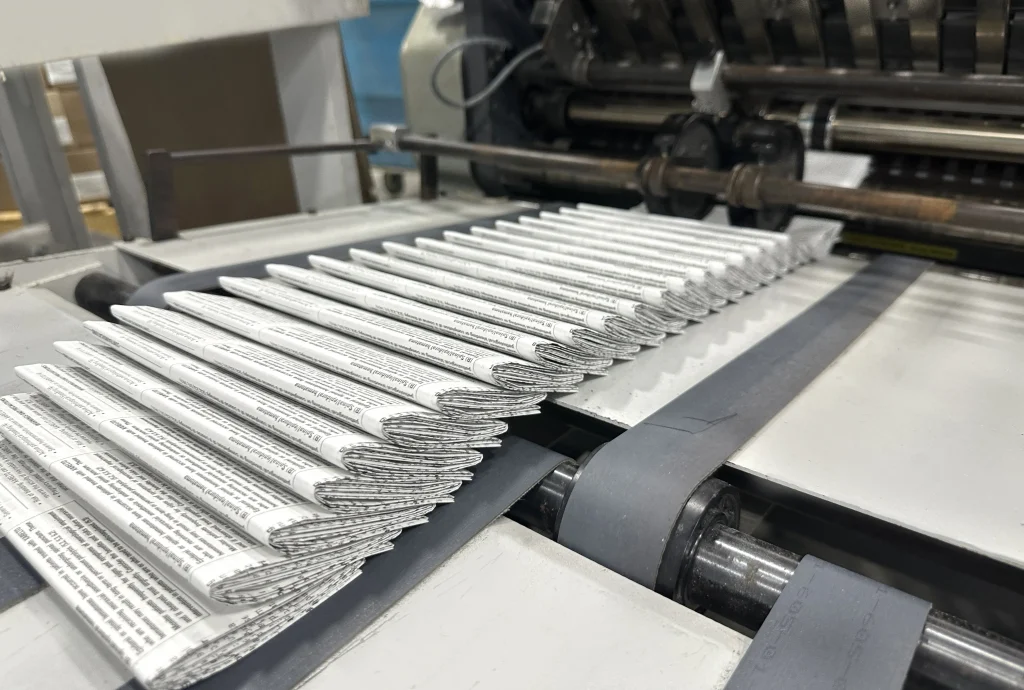
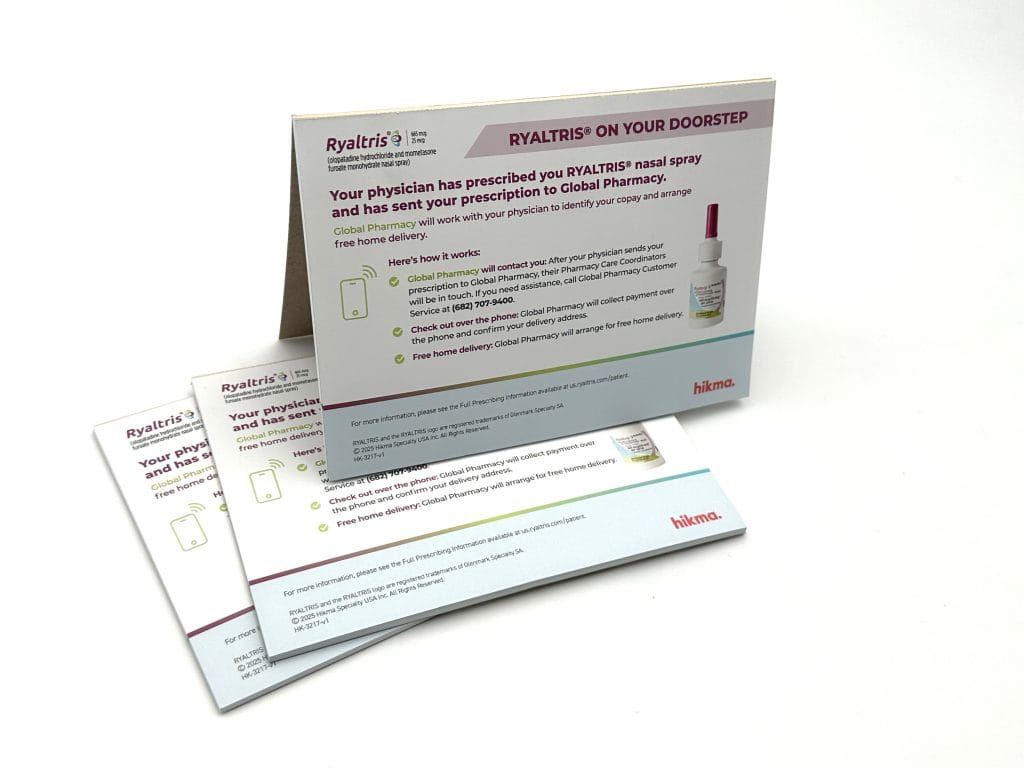
Tearpads are among the most useful pieces in the pharma collateral toolkit. Placed in exam rooms or waiting areas, they give patients something concrete to take home and reference later: dosing reminders and disease education, or a list of questions to bring to the next appointment. Designed for quick consumption and easy distribution, their value is directly tied to how clearly they communicate a single, focused piece of information. A tearpad that tries to cover too much stops functioning as a quick-reference tool.
Patient Package Inserts and Medication Guides
Patient package inserts and medication guides are FDA-mandated materials written in plain language for patients, covering safe and effective drug use and the associated risks. Unlike prescribing information, which is written for healthcare professionals, PPIs and medication guides are written for the person taking the medication. Regulatory requirements govern their content and distribution, and accuracy is non-negotiable. Both are produced in high volumes and frequently updated alongside labeling changes.
Co-pay and Savings Cards
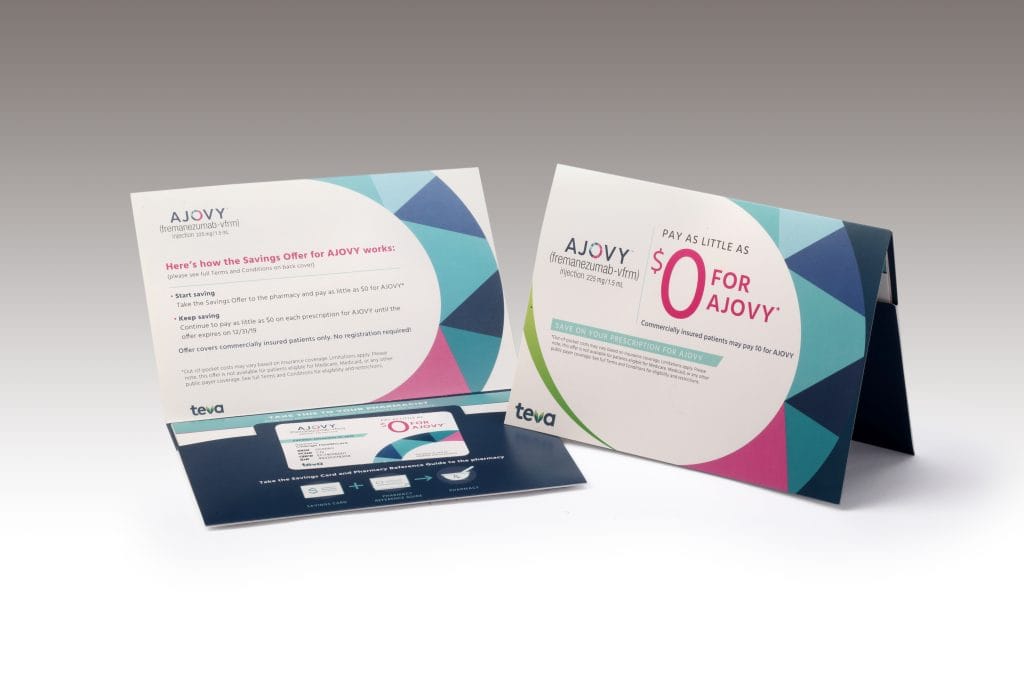
Cost is one of the most common reasons patients abandon or delay filling a new prescription. Co-pay and savings cards directly address that barrier by reducing out-of-pocket expense, helping branded medications remain accessible when lower-cost alternatives exist. The card has to communicate program terms clearly and hold up physically through the patient’s use of it at the pharmacy counter, while integrating cleanly into whatever kit or detail aid it accompanies.
A few considerations that pharma brand teams consistently navigate when building patient-facing collateral programs:
- Regulatory review timelines that affect when materials can be finalized and sent to production
- Version management across large distribution networks, where outdated materials reaching patients can create safety and compliance concerns
- Kitting configurations that need to stay consistent across thousands of assembled units
- Variable data requirements for personalized inserts or segmented campaign materials
- Distribution coordination that ties to launch timing and formulary milestones
The Production Considerations That Set Pharma Apart
Knowing which materials a program needs is one challenge. Getting all of them produced correctly and delivered in the right quantities at the right time is a different one entirely.
Pharmaceutical collateral programs introduce production variables that most other industries don’t face. Label updates and regulatory approvals rarely arrive on a convenient schedule. A brand team may be working from approved creative while the final prescribing information is still in review, which means production decisions around format and quantity have to be made under uncertainty. Print-at-risk scenarios, where production begins before final regulatory signoff to meet a launch date, require a production partner that understands both the process and the exposure.
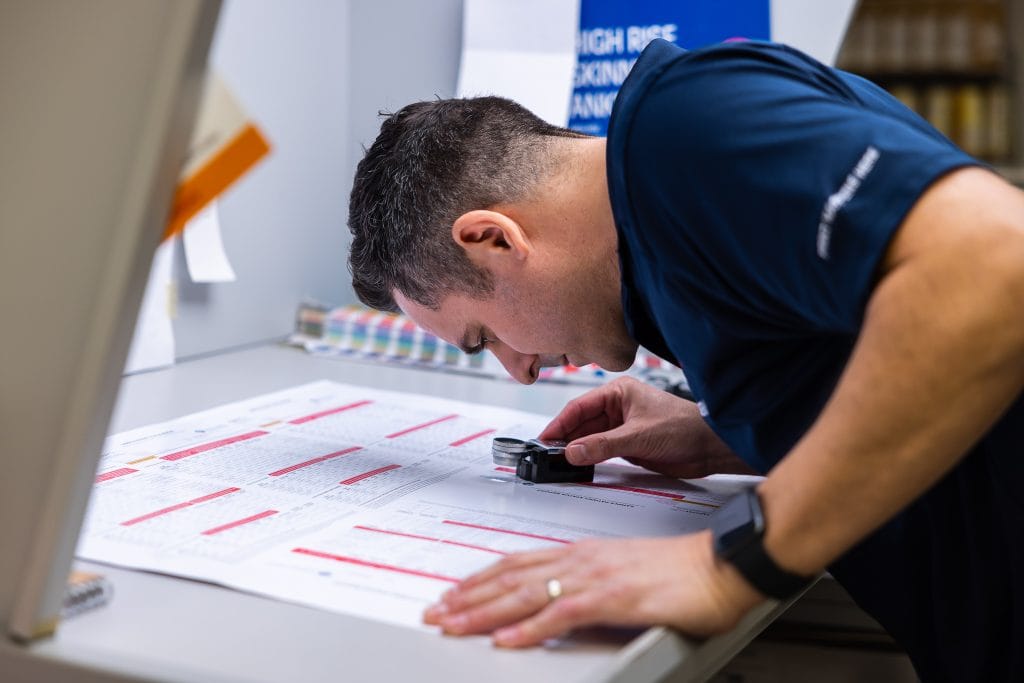
Version control is a persistent operational concern. When a label is updated or an indication changes, every piece of HCP and patient collateral that references affected language needs to be identified and pulled from distribution before a replacement version ships. In a program managing dozens of material types across hundreds of distribution points, that process has to be systematic. Informal tracking creates gaps, and gaps in pharma collateral management carry real risk.
Launch timing adds another layer. Day-one delivery expectations for a new drug launch mean that materials have to be fully produced and quality-checked before a date that may shift more than once during the planning cycle. The burst capacity to absorb those changes without degrading quality or accuracy is not a given across all print and fulfillment providers.
For brand teams evaluating production partners, the questions to ask go beyond price and turnaround time.
How does the partner manage regulatory-driven reprints? What does their version control process look like? How do they handle kitting configurations that require precise assembly across high volumes? Do they hold the certifications pharmaceutical brands require, including HIPAA compliance and ISO 9001 certification?
The pharmaceutical printing and fulfillment capabilities a brand team relies on need to hold up under those conditions, not just the straightforward ones.